Not the First Doomed Generation, But Perhaps the Most Watched
How children and adolescents make meaning under conditions of ambient threat, unstable adulthood and a permanently mediated world

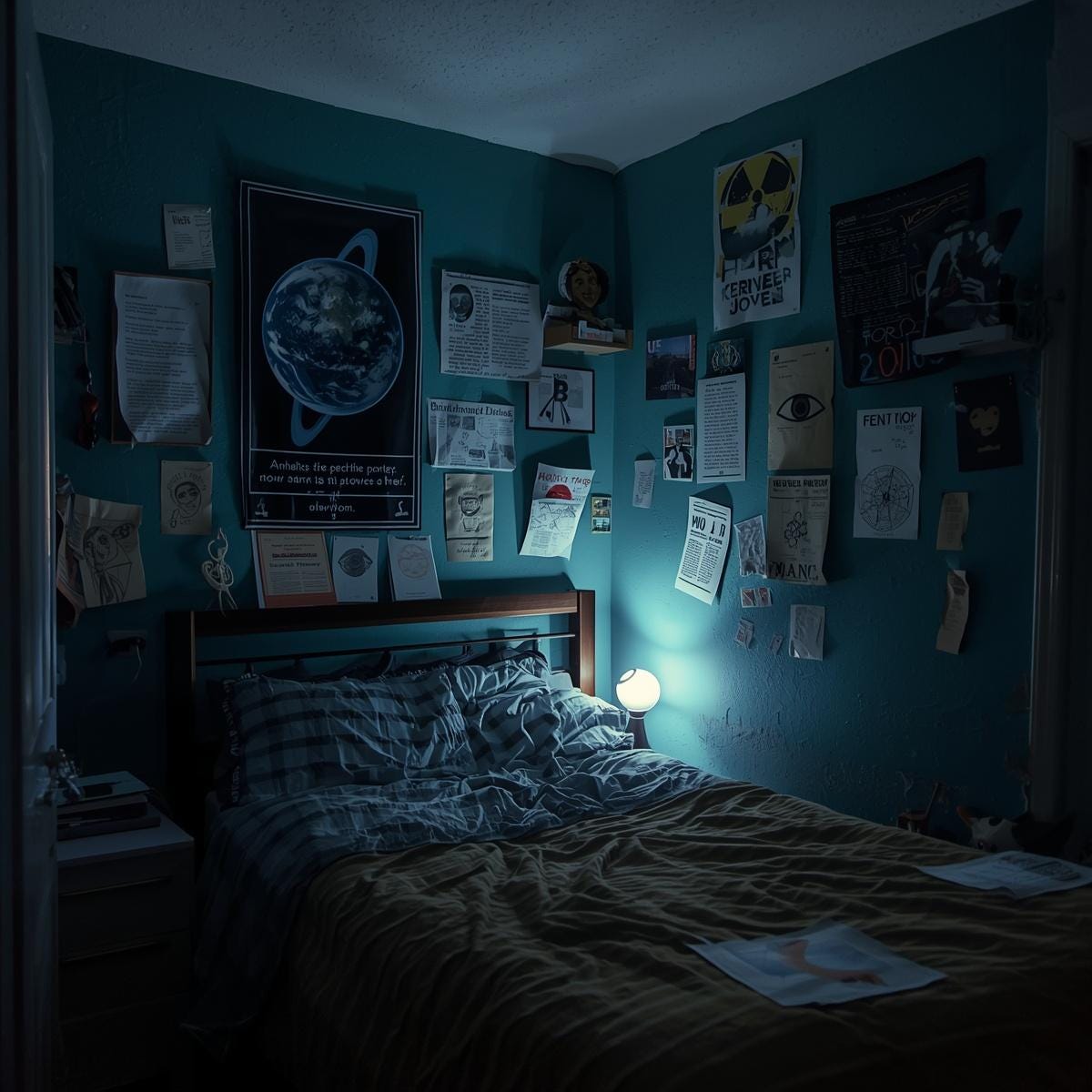
Every generation likes to imagine itself living at the edge of something: a war, a collapse, a moral decline, a new dawn. Adults often tell themselves that children today have it easier, softer, safer than those who came before. More comfort, more rights, more protection, more knowledge. In some ways, that is true. A child in Britain today is less likely to die of infection, famine or industrial injury than a child born into most previous generations. They are more likely to be vaccinated, educated, protected by law, listened to by professionals, and offered a vocabulary for feelings, identity, difference and harm.
But safety is not only a matter of calories, antibiotics or central heating. It is also a matter of whether a child feels there is a future worth entering. Whether adulthood looks imaginable. Whether the world ahead feels stable enough to invest in. Whether the people in charge seem serious, truthful and able to act. A society can keep more children alive and still fail to make life feel liveable. It can build safeguarding systems, mental health strategies, digital literacy programmes and online safety legislation while leaving children with the deeper impression that no one really knows what they are doing.
Children and young people today are not the first generation to grow up under existential threat. The Cold War cast a long shadow over childhood for decades. Many young people lived with the background knowledge that the world could end in minutes, at the whim of men in suits and bunkers. Nuclear winter gave form to a fear that was not only about war, but about the earth itself being altered beyond recognition. Before that came world wars, plague, famine, economic depression, empire, forced labour, state terror and the ordinary brutality of lives lived much closer to death than most children in wealthy countries experience now.
So this generation is not uniquely cursed. Human beings have always raised children under conditions of danger. What is different is the way danger is now narrated, mediated, personalised and carried. A child in the 1980s might have feared nuclear war, but that fear had edges. It arrived through television news, adult conversation, school culture, protest, music, nightmares, jokes. It could be folded into punk, dark humour, CND badges, classroom dread, family silence or adolescent fatalism. It was frightening, but it was not usually delivered through a device that also contained your friendships, homework, games, pornography, music, humiliation, status, gossip, fantasies, AI companionship and the possibility of being watched back.
That difference matters. Today, the end of the world does not arrive as one event. It arrives as a feed. Climate breakdown, biodiversity loss, democratic decay, economic precarity, war, pandemics, loneliness, housing unaffordability, AI, addiction by design: none of these are imaginary and none are trivial. Taken together, they create an emotional atmosphere in which catastrophe is both distant and intimate. Floods, heatwaves, school absence, ecological grief, violent clips, conspiracy threads, AI-generated images, another headline, another warning, another adult saying we are running out of time. The child does not encounter these things separately from ordinary life. They arrive between jokes, messages, music, edits, gaming clips, influencers, homework, family photos and whatever else the algorithm has learned will keep them there.
That is the part our public conversation still struggles to hold on to. Children are not simply “accessing information”. They are growing inside environments designed to hold attention, intensify feeling, reward reaction and learn from vulnerability. A teenager does not have to search for despair in order to be shaped by it. Their curiosity, loneliness, fear, shame, boredom, loyalty, status anxiety and wish to belong are all signals in systems that adapt around them. A child who pauses over one video, watches one clip twice, follows one account, lingers over one argument, or searches one phrase may find the world rearranging itself around that moment.
Ofcom’s latest Children’s Media Lives research is useful here because it shows how ordinary this exposure has become. Nearly three-quarters of 11 to 17-year-olds in the study said they had seen harmful content online, and personalised feeds were a major route into it. At the same time, most children still reported feeling safe and happy on social media and messaging services at least most of the time. That apparent contradiction can be important. Online life is not only harm. It is friendship, humour, creativity, music, comfort, identity, learning and relief. The problem is that harmful material is woven through the same spaces where children socialise, relax and become themselves. It is not always hidden in a dark corner. Sometimes it is sitting in the middle of ordinary use.
This is why the old split between “real life” and “online life” is now actively unhelpful. For children and adolescents, the phone is not a separate world they visit and leave. It is part of the social weather. It is where status is tested, friendships are maintained, jokes are shared, humiliations are replayed, conflicts escalate, rumours travel, identities are tried on, bodies are compared, money is imagined, violence is stylised, and fear is given aesthetic form. It is also where some children find help, language, community and escape. The trouble is that the same design features can serve both needs. A system built to keep a lonely child company can also keep them alone for longer. A system that offers belonging can also make exit feel socially impossible. A system that gives a child language for distress can also turn distress into identity, performance or contagion.
When adults talk about “eco-anxiety” or “youth mental health”, they sometimes flatten what is happening into pathology, as though children are simply overreacting to information. But despair is not always irrational. Sometimes it is an intelligible response to contradiction. We tell young people to plan for the future while giving them every reason to doubt that the future will hold. We tell them to revise, behave, persevere and aspire while public life becomes visibly frayed. We tell them to get help while waiting lists stretch beyond any meaningful adolescent timescale. We tell them to stay safe online while some of the most powerful companies in the world are still allowed to build environments that reward compulsion, extremity and endless return.
The effects of this are uneven. Some young people become activists. Some become studious and dutiful. Some turn towards religion, community or service. Some narrow their focus to friendship, fitness, money or self-improvement. Some become beautifully practical, learning to cook, save, code, train, repair bikes, look after siblings, research politics, join campaigns or make art. Others disappear into gaming, pornography, substances, self-harm, status, money, fantasy or sleep. Some make jokes because joking is easier than saying they are frightened. Some drift towards a colder conclusion: nothing matters, no one is coming, adults are frauds, the future is a scam.
That colder conclusion does not make a child monstrous. Most young people who feel despair will never become violent. Most will carry it as anxiety, avoidance, anger, exhaustion, humour or numbness. They will still love their friends, feed the dog, revise for exams, scroll their phones, worry about their skin, argue with their parents and wonder whether anyone will ever really understand them. But a small number will find scripts that give despair shape, and the online world is now full of scripts.
This is where nihilism begins to matter, not as a grand philosophy but as a mood: a thinning out of moral and emotional investment, a refusal to build because building feels absurd, a habit of ironic detachment, a deadening of sympathy, a retreat into fantasy, performance or the digital elsewhere. For young people already carrying trauma, exclusion, humiliation, neurodivergence, chronic dysregulation or social defeat, that mood can become dangerous. If the future feels unreal, consequence weakens. If institutions feel false, norms lose their force. If nothing is sacred, destruction can begin to look like expression.
In the most extreme online spaces, nihilism can harden into something more organised. Recent work from GNET, GIFCT and ISD on nihilistic violent subcultures is useful because it does not try to force these spaces into older models of ideology or group membership. These ecosystems can be decentralised, cross-platform and agile, using mainstream and fringe platforms for grooming, propaganda, status, humiliation, coercion and operational coordination. They do not always look like formal organisations. Sometimes they look like jokes, dares, aesthetics, private chats, gore-sharing, blackmail, misogyny, racism, sadism, status games or a fantasy of being beyond ordinary morality.
That does not mean every confused, despairing or violence-fascinated young person belongs to such a subculture. It does mean we need to pay attention to the way despair, grievance and spectacle can be turned into pathways. Some manifestos and livestreams are not coherent political statements so much as bait, designed to provoke blame, inflame racial, religious, gendered or political divisions, and turn the aftermath of an attack into part of the attack itself. Violence becomes message, meme, recruitment tool and performance. The wider public then does some of the distribution work, often without meaning to, by arguing over the script the attacker wanted us to fight about.
There is a parallel problem with conspiracy and “hidden truth” content. Adolescence is often the point at which questions about truth, power, reality and meaning intensify. Big metaphysical ideas, conspiracy narratives and philosophical speculation can become compelling not simply because a young person is gullible, but because they offer something emotionally useful. They turn chaos into pattern. They promise depth beneath surface falsity. They make the child feel less passive in a world that appears unstable, deceptive or out of control. Curiosity is not pathology. It is normal for adolescents to ask what is true, who is lying, what kind of world this is and what lies behind appearances. But in unsafe or destabilising conditions, the search for truth can become a search for total explanation. The wish to make sense of uncertainty can become an attraction to systems that explain everything at once.
This is why simple debunking so often fails. A teenager drawn to hidden truths may be reaching for structure, seriousness and a feeling that reality can still be grasped. The falsehood may be doing emotional work. It may organise fear, feed a longing for agency, offer special knowledge, or turn humiliation into superiority. Nihilism and conspiracy can look like opposites, but they often sit close together. One says nothing matters. The other says everything is secretly connected. Both can grow where trust has thinned, shared reality feels weak and the future no longer seems securely held.
What makes the current moment so difficult for parents, teachers and safeguarding professionals is that the child may be both highly visible and profoundly unknown. They are watched by platforms, watched by metrics, watched by peers, watched by schools, watched by parents through location tracking and monitoring apps, watched by strangers through screenshots, follows, comments and shares. Their behaviour may generate records, alerts, logs, dashboards and reports. Yet none of this guarantees that an adult understands what the child is living inside. A parent can see the location dot and still not know the social atmosphere around the child. A school can record incidents and still miss the humiliation, exclusion or manipulation that made those incidents more likely. A platform can remove some of the worst content while leaving intact the design choices that route children towards the next provocation.
This is one of the central mistakes in the current safety debate. We keep reaching for more visibility as though visibility itself were protection. Sometimes monitoring is necessary. There are children who need protection from grooming, exploitation, violent content, pornography, self-harm material, coercive groups and adult predators. Parents need practical controls. Schools need ways of noticing serious risks. Regulators need evidence. Platforms need to be forced to assess and reduce the harms their own systems create. But surveillance is not care. A child can be monitored constantly and still feel profoundly alone. Being watched is not the same as being supported.
The real question is not only whether harmful content can be found and removed after a child has already encountered it. The harder question is why the child was routed there in the first place. That brings us from content to architecture: recommender systems, infinite scroll, autoplay, streaks, loot-box mechanics, variable rewards, contact-by-default settings, weak age assurance, group chats that allow adults to reach children, frictionless sharing, algorithmic amplification and product changes pushed into children’s lives before risk has been properly assessed. Ofcom’s March 2026 industry bulletin is significant because it names algorithms as children’s main pathway to online harm and says platforms must assess significant updates before they are deployed. That is not a small technical point. It recognises that design choices are not neutral plumbing. They can make risk predictable, and if risk is predictable, it is also governable.
This is also why the work of organisations such as 5Rights and the Digital Futures for Children centre matters. Their recent analysis of regulation across social media, gaming and AI chatbots asks whether law is beginning to change the design and governance of platforms children actually use. That is the right level of analysis. The question is not simply whether an individual child, parent or teacher made the right decision on a difficult day. It is whether the environment was designed in ways that made foreseeable harm more likely, and whether regulation is strong enough to change that design rather than merely tidy up after it.
Governments are beginning to act as if childhood should not be left entirely at the mercy of platform design, but they are not all doing the same thing. Australia has already enacted a hard under-16 social media law, requiring covered platforms to stop most children under 16 from holding accounts. The UK has not. Britain is still consulting on whether to move beyond the Online Safety Act’s child-safety duties into something closer to a true age ban. Canada has introduced legislation that would ban under-16s unless platforms can meet strict child-safety standards, but that is not yet in force. France is among the closest European comparators, while a wider group of countries is exploring parental-consent rules, tougher age checks or stronger design regulation. The direction of travel is clear enough. Governments are losing faith in the idea that platforms can be trusted to self-regulate childhood. But the policy tools remain uneven, and none of them answers the deeper question of what kind of world children are being asked to grow up into.
At the moment, public debate still gets trapped between two inadequate answers. One answer says: ban children from everything. The other says: teach resilience and digital literacy. Both contain something true, but neither is enough. Children do need education. They need critical thinking, media literacy and adults who can talk to them about manipulation, pornography, gambling-style design, misogyny, racism, conspiracy, AI, scams and violent online cultures without panic or shame. But no amount of digital literacy can make a child developmentally equal to an industry that tests, optimises and monetises attention at scale. Equally, bans alone will not solve the problem if children simply migrate to less visible platforms, gaming spaces, VPNs, private servers, encrypted chats or adult accounts. A ban may reduce access to some harms, but it does not build the relational, civic or technical infrastructure children need.
The better question is not only whether children should be allowed in a particular online space. It is why so many spaces have been built in ways that harm children predictably, then leave exhausted adults to manage the consequences. Parents should not have to become full-time digital forensic investigators. Schools should not be left to absorb the fallout from commercial design. Safeguarding systems should not have to wait until a child has already been pulled into something dangerous before they can see the pattern. Safety should not depend on the most exhausted adult in the house finding the right setting in the right app at the right time.
That is what Safe by Default means to me. It means default private accounts for children. Strong age assurance where risk demands it. No adult contact by default. No addictive design aimed at children. No recommender systems pushing harmful content into children’s feeds. No product testing on children without meaningful child risk assessment. No AI companions normalised for children without serious attention to dependency, emotional vulnerability, accuracy and safeguarding. Better red-teaming before features are released, especially for harms that are not hard to predict once you look at the child in context rather than the average user in a product demo.
But design is only part of the answer. Children also need adults who can bear reality without handing despair back to them. They do not need a fantasy of perfect safety, and they do not need adults pretending the world is fine. They need adults who can say, in words and actions: yes, there is danger; no, you are not mad for noticing; no, the future is not guaranteed; yes, your actions still matter; yes, other people still matter; no, destruction is not depth; no, cruelty is not intelligence; no, detachment is not freedom; yes, we still have to live as if repair is possible.
That kind of containment is harder than reassurance and deeper than surveillance. It means truthful language, proportion, practical action, ordinary routines, trusted adults, safe public space, youth work, schools that can respond to difference without humiliation, and mental health support that arrives before crisis has calcified. It means systems that can tell the difference between a child who is dangerous, a child who is frightened, and a child who has been made dangerous by the places they have been left to grow.
Too often, adult systems offer either panic or platitude. We catastrophise or minimise. We tell young people everything is urgent, then give them no meaningful role in changing it. We tell them their voices matter, then place them inside consultations where power has already decided the shape of the answer. We tell them to be safe, but leave them alone with systems designed to intensify whatever already hurts. When some young people then become unreachable, we ask what went wrong with them.
Every generation grows up with danger. But not every generation grows up so completely watched, so relentlessly informed, so commercially profiled, so algorithmically nudged, and so uncertain whether anyone is actually in charge. The question is not whether young people are too fragile for reality. It is whether reality is being mediated to them in ways that strip away agency, solidarity and meaning before they have had a proper chance to begin.
Further reading
Ofcom, Children’s Media Lives 2026 / Younger phone owners, the rise of AI, and consumption over creation. Useful for recent UK evidence on children’s exposure to harmful content, personalised feeds, AI use and how online spaces remain socially meaningful for children.
Ofcom, Online Safety Industry Bulletin, March 2026. Useful for the current regulatory focus on recommender systems, age assurance, product testing on children and enforcement.
5Rights Foundation / Digital Futures for Children, Impact of Regulation of Children’s Digital Lives – Phase II. Useful for understanding whether regulation is beginning to change platform design across social media, gaming and AI chatbots.
GNET / GIFCT / ISD, Beyond Extremism: Platform Responses to Online Subcultures of Nihilistic Violence. Useful for the section on nihilistic violent subcultures and why older extremism models do not fully fit this landscape.
UK Government, Growing up in the Online World: A National Conversation. Useful for situating the essay within current UK policy debates about children, smartphones, social media and online harm.